Do you remember the comedic genius of Nathan Birnbaum and Mendel Berlinger? Or the graceful movements of Frederick Austerlitz and Virginia McMath? How about the cinematic offerings of Lucille LeSeuer, Issur Demsky, Frances Gumm, and Bernard Schwartz?
No? What about (in order) George Burns, Milton Berle, Fred Astaire, Ginger Rogers, Joan Crawford, Kirk Douglas, Judy Garland, and Tony Curtis? I get that only those of a certain age who are reading this may recognize these stage names, but to my point, it’s not uncommon for celebrities of any generation to change their names.
Some have done so in order to eschew their ethnicity and gain the acceptance of the consuming American public by means of something more mainstream and ear-pleasing. Some needed more memorable monikers. Take, for example, Arnold George Dorsey (aka Engelbert Humperdinck). That’s one you don’t soon forget.
Did you know Ralph Lauren’s birth name was Ralph Lifshitz? He and his brothers changed their surname to Lauren after being bullied. And I think that worked out well for Ralph. “Polo” by Ralph Lifshitz just doesn’t have the same appeal.
“Who are you wearing tonight?”
“Ralph Lifshitz.”
We’ve all heard of famous folks who named their children something outrageous or otherworldly, ranging from Frank Zappa’s kids Moon Unit and Diva Thin Muffin Pegeen to Elon Musk’s progeny X Æ A-12 and Techno Mechanicus.
No, thanks. Just call me Ralph Lifshitz.
I find name changes interesting. Many immigrants to the United States underwent them, becoming more anglicized. My surname evolved from “Hermann.” My “Farmer” ancestors were originally “Bauers,” “bauer” being the German word for “farmer.” Over time, the surname “Fritts” (at least near where I live) underwent one of the most remarkable transformations I’ve encountered, from “Treffenstatt” to “Stufflestreet” to “Fritts.” Thankfully, they bypassed “Snuffleupagus.”
In 1942, in the midst of the world war, a distant cousin of mine was born and given the first and middle names Hitler Stalin. Talk about setting a kid up for failure! For the life of me, I can’t fathom what his parents were thinking. Sadly, the boy died at the age of one month from influenza, but had he lived, and had he not chosen to change his name, imagine what his life would have been like.
And Ralph Lifshitz thought he had it rough.
Many names have meanings that can be traced to ancient origins. My given name, “Terry,” seems not to have any meaning of its own, but it’s believed to be derived from the Latin “Terence,” which means “soft,” “smooth,” or “grain thresher,” or from the Germanic/French “Theodoric” or “Thierry,” meaning “powerful” or “ruler of the people.” My man card is inclined to choose powerful over soft, but, believing a "real man" can and should be confident and assertive yet sensitive, I’m finding satisfaction in the combination. After all, I could have been named Byron, which is derived from an Old English word meaning “cowshed.” Shed! I said shed! (My apologies to all the Byrons out there.)
Some people have short names; others have long ones. An example of the former is “J,” a child born in India in 2013. Compare that to the man who holds the Guinness World Record for the longest personal name, featuring more than 2,200 words. For short, he goes by “Laurence Watkins.” [“Just call me Larry.” Not sure how to explain his brother Darrell and his other brother Darrell. I guess the parents exhausted their creativity on Larry.] There is also Hubert Blaine Wolfeschlegelsteinhausenbergerdorff Sr. [You mean there’s a Jr.?]
And then there’s Rhoshandiatellyneshiaunneveshenk Koyaanisquatsiuth Williams, which is the abbreviated version of a 1,000-letter woman’s name. [I like to imagine she married Bob Tnjhcdykesurkzfnkrdytersjgdrlkhdjhfkesurthlrkfnglkdfhweutyeduew and hyphenated her name.]
Some people have humorous names. Another distant cousin of mine, Russell Pipes, was called “Rusty” for short. When I worked in a university registrar’s office, I knew of a student named Heiny White, whose academic records, when filed last name first left a whole new impression. Then there was another student named Angela Corn, who was not at all amused when one of our staff told her he thought he knew her uncle, Jimmy Crack.
On a more serious note, I’ve recently been studying the Biblical book of Luke which contains, in part, Jesus’ initial encounter with Simon, who would become one of his disciples. “Simon” means “hearing” or “listening,” and Luke depicts Simon as one of the first individuals to really comprehend what Jesus was saying about Himself as the Messiah and the fulfillment of God’s promises.
Matthew’s Gospel informs us that, later on, when Jesus asks Simon, “Who do you say that I am?” and Simon responds, “You are the Christ, the Son of the living God,” Jesus says, “Blessed are you, Simon…I also say to you that you are Peter [derived from “Petra” meaning “rock”], and on this rock [not Peter himself, but the truth that he spoke about Jesus] I will build my Church, and the gates of hell shall not prevail against it.”
The Bible also speaks about the importance of having a good name – not in the sense of a pleasant- or strong-sounding name, but in the deeper sense of who we are as people. When others hear your name, what comes to their minds in terms of your character and your reputation? Scripture teaches us that a good name, in these contexts, is more precious than great riches and precious ointment, and it stresses that the way we conduct ourselves and relate to others is critical. It speaks of our honesty, our integrity, our love and compassion.
Many years ago, my paternal grandfather gave me a mail-order plaque. It doesn’t have great monetary value, but it has enormous intrinsic value to me because it expresses something he believed to be important enough to impart to me, and here is what it says:
“You got it from your father; it was all he had to give. So, it’s yours to use and cherish for as long as you may live. If you lose the watch he gave you, it can always be replaced, but a black mark on your name, son, can never be erased. It was clean the day you took it and a worthy name to bear. When he got it from his father, there was no dishonor there. So, make sure you guard it wisely, after all is said and done, you’ll be glad the name is spotless when you give it to your son.”
Granted, I don’t have a son to pass the plaque or the name on to, but it’s the principle behind the plaque that matters.
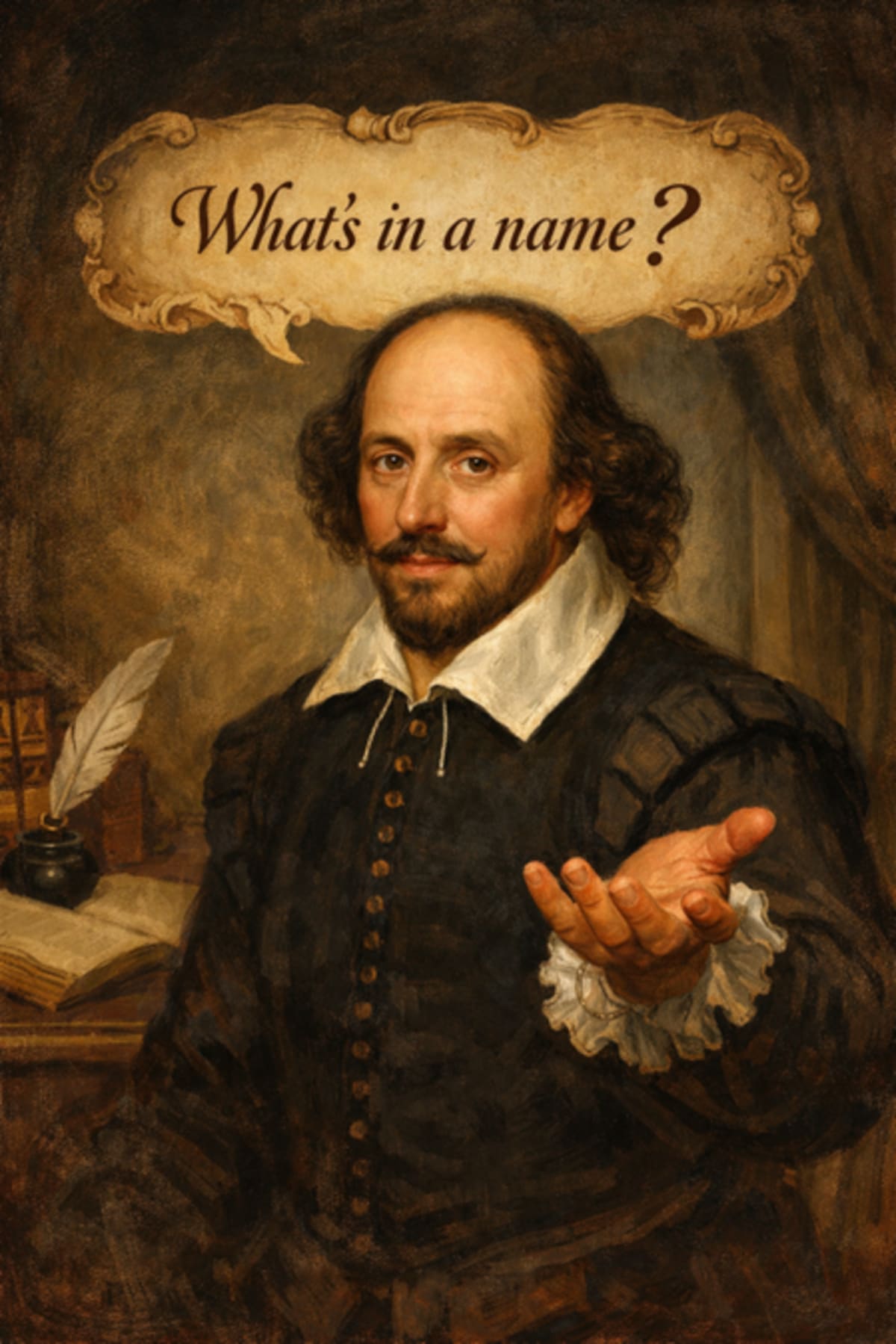
In Romeo and Juliet, Juliet asks, “What’s in a name?” The implication of her question is that a name is merely a label and not something that defines one’s essence.
I don’t care if you’re Mendel Berlinger, Ralph Lifshitz, Techno Mechanicus Musk, Hubert Blaine Wolfeschlegelsteinhausenbergerdorff Sr., Heiny White, or Thierry Hermann, in light of the increasingly divisive, cold, and often times cruel world we inhabit, the thing that truly matters is not what you’re called but who you are.
My prayer is that we all, more and more, would have our name associated with the Name of Jesus, that we would reflect His character, and that we would love as He has loved.