One of my 3x great-granduncles was Matt Banner, who, when he inherited a portion of his father’s North Carolina plantation, asked that it be sold so that he might be educated at a school of dentistry in New York City. He subsequently established a thriving dental practice and drugstore in Dalton, Georgia, where he met his future bride, Addie. Aunt Addie was a graduate of the Knoxville Female Seminary in Tennessee and a teacher, and she and Uncle Matt married in 1856. At their wedding, she tripped coming down the stairs and fell into his arms.
In 1862, during the Civil War, Uncle Matt enlisted in the Confederate Army. He first served with the Georgia Volunteer Infantry and subsequently with the 39th Georgia Regiment, and he ultimately held the rank of lieutenant. The following year, he was stationed in Vicksburg, Mississippi during the long siege on that city and witnessed its fall.
Uncle Matt kept in touch with his wife and children via a series of letters, which gave insight into his life during the war. Among the things he wrote her about were his wellness and his diet. With a few exceptions, his health was good, but fever and smallpox threatened the camp, and diarrhea was common. He primarily lived on cornbread, bacon, and molasses. At other times, he had bread, beans, and rice, but he avoided the beef as it was of very poor quality. On one occasion, he was able to go to a local house, where he bought himself breakfast for a dollar.
According to Uncle Matt, Vicksburg, at least for a while, was the worst place he and his fellow soldiers had been in terms of provisions. He wrote of how the men grumbled about the food, and how it ought to be quickly remedied “as men will not make good soldiers if they are not fed.” Some of the men, “swearing they would have meat,” went outside the camp and shot three or four hogs but were arrested afterwards. “Unless the government feeds them better,” Uncle Matt said, “I fear there will be some difficulty as the fare is almost beyond endurance.”
Uncle Matt also expressed his desire for the war to end. In a particular letter from Vicksburg, he shared that spring was on its way. The grass was greening, peach trees were blooming, and frogs were hollering. “Oh, if we could only get peace as soon and sure as spring comes, but alas, I fear we will have many hard battles before we know peace.” He said that newspaper reports of peace had ceased to make an impression on him, and he did not believe a fourth of what he heard.
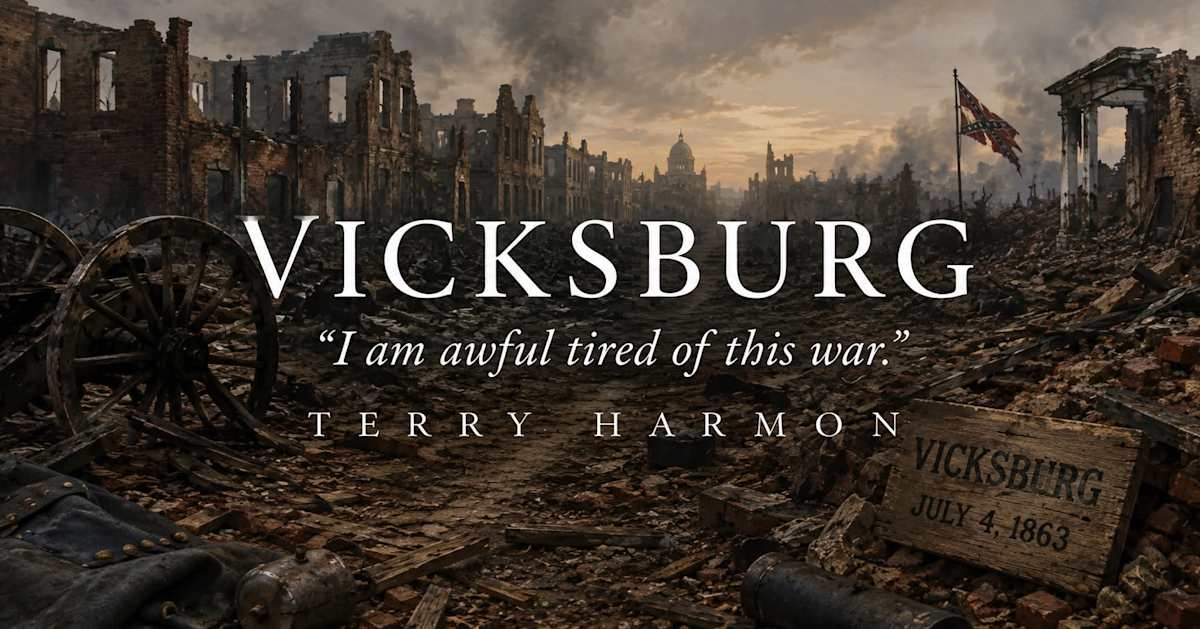
At other points in time, he wrote, "I am awful tired of this war" and “I see no prospects of the war closing. In fact, if our folks do not conclude to compromise, we will have to be subjugated or killed; for old Abe now has the men and money voted to him to carry on the war for the next eighteen months, unless Providence intervenes in our behalf….”
Regarding the everyday ins and outs of war, Uncle Matt shared in his letters home what he had seen firsthand. “They (The Yanks) are in sight of here. Up the river, their fleet looks like a small city in the distance…. We have no idea when they will attack this place. Nearly every day there is firing going on….” He witnessed the shelling of two gunboats. “’Twas a grand sight,” he said. He saw another gunboat sink, and although some of the “Yanks” onboard got into skiffs or jumped in the river and swam, he was sure many of them drowned. “I could be but sorry for them and invoked God to have mercy on their souls.”
He wrote of attending the execution of one of three soldiers who had deserted and gone over to “the Yanks.” “It was a sad! sad! sad! sight to me.” The soldier, dressed in a Federal uniform and a white shroud and being attended to by a minister, was brought out in a wagon, riding in his own coffin. He was then tied to a stake and blindfolded. After his sentence was read, a guard of twelve men stepped forward and fired into his breast, “and his soul was launched into eternity.”
On Easter morning, 1863, Uncle Matt, near his camp on a high bluff overlooking Chickasaw Bayou outside of Vicksburg, wrote another letter to his “ever dear wife.” He told of the tremendous view from that vantage point of the smokestacks of Yankee gun boats ascending the Yazoo and Mississippi Rivers. If any of them attempted to run the Confederate blockade, he wrote, “we would have some grand music here.”
Early on, Uncle Matt shared that “writing and reading my Bible are the only pleasures I have,” but those seem to have gradually expanded as he later wrote of a favorite spot, where he could wander off to himself and enjoy the sweet singing of a large number of birds, including English Mockingbirds. He noted that, “all nature seems joyful this morning, save man.” Even later, he told of finishing Tannhäuser, a lengthy poem grappling with the tension between earthly desire and spiritual devotion.
At times, he stood in need of clothing, and he wrote his wife, asking that items be sent to him – a coat, two pairs of socks, and two shirts made from any good, strong cloth that could be found. He once acknowledged receipt of a letter from home, wrapped in a pair of drawers – an added bonus for which he was sincerely grateful. At another point, he wrote, “I am needing my shirts very much – am nearly naked.”
During the month of April, there was much anticipation concerning Union forces attacking Vicksburg. Uncle Matt was anxious for a battle and confident in the Confederate troops. “I think we will whip them.” He wrote that the “Yanks” were threatening the city, but “they will lose every boat, for we can sink them all in a very few minutes…. I have no fear of their ever taking the place…they are too smart to attack…. And if they cannot take this place in the course of two months, they will have to leave.”
In May 1863, Gen. Ulysses S. Grant’s forces began to surround the city. They assaulted it on May 19 and 22 but were repulsed and suffered the loss of more than 4,000 men. Realizing that the city could not be taken by storm, artillery batteries were set up around it, and the formal siege began to starve it into submission. By the end of June, the Confederates had little hope of relief and no chance of breaking through the Federal lines.
In the midst of the siege, Uncle Matt again wrote home: “Through the providence of God, I am yet safe, but how long I will remain so, I am unable to say. We have held this city against a large force of the Federals now for thirty-five days on one-third rations. And now I hear the distant booming of cannon. My heart is elated with hope that it is the long expected [Gen. Joseph E.] Johnston coming to our relief. Oh! That God will give us a great victory here. That it may speedily bring about a peace for our distracted country.”
But victory was not to belong to the Confederates, and on July 4, 1863, 49 days since they began fighting, they submitted their stronghold and their garrison of 32,000 to Grant and his forces. For seven weeks, Vicksburg had held out while being shelled day and night. The citizens huddled in basements and caves, eventually having to subsist on mule meat and rats. Uncle Matt wrote, “Our rations ran out today…. Yesterday, the 3rd, was the first day that we had mule beef issued to us I have not yet tasted it but fear I shall have to do so in a day or two. There is some talk of our cutting out through the Federal lines, but I hope our Generals have more sense than to attempt such a sacrifice of the men as they have been kept in the trenches so long and on one-third rations that they are not able now to walk five miles….”
A week and a half later, Uncle Matt wrote, “I am once more outside of the Yankee lines…. I thank God I came out safe though the balls and shells were falling around me thick and fast for 47 days and nights…” He was soon after furloughed at Enterprise, Mississippi. His regiment was exchanged and assigned to the Army of Tennessee where he served till the war’s end and participated in many major East Tennessee battles, including the November 1863 “Battle above the Clouds” at Lookout Mountain near Chattanooga. He was wounded in that battle, and in all, he was wounded three times during the war. In one instance, a Minié ball was stopped when it hit a coat button and a New Testament in his shirt pocket. It bruised his lung causing a hemorrhage, and he was carried off the field for dead.
On April 12, 1865, three days after General Robert E. Lee surrendered at Appomattox, Virginia, Uncle Matt was discharged from the Army of Tennessee when his regiment was consolidated with others. He soon wrote Aunt Addie: “The war is about over, and I thank God for it.”
In March 1863, Uncle Matt had received word from Aunt Addie that their home in Georgia had been burned. During much of the last two years of the war, it was necessary for Aunt Addie and their children to return to her hometown of Charleston, Tennessee where her family could assist them. Although Aunt Addie had serious eye problems and was very frail, she dedicated her life to her family, church, community, and the many children she taught. In Charleston, teaching school enabled her to find refuge from her worries.
When Uncle Matt and Aunt Addie returned to Georgia with their family, they found their Dalton home and business in ruins. Even their water well was filled with stone and brick. Uncle Matt’s health was very poor, the result of the wounds and exposure he suffered during the war, and he practiced little dentistry as a result. Despite financial difficulties and the loss of his earthly possessions, he kept his hope and faith. The war years had been difficult, but neither Uncle Matt nor Aunt Addie dwelled on their hardships.
Uncle Matt’s physician eventually recommended that he move to the mountains, and in 1872, he relocated his family to Banner Elk, North Carolina, where his brothers assisted him in every way possible, and where he and Aunt Addie soon made many new friends. They welcomed neighborhood youth into their home as well as boarders – professors, artists, fishermen, and businessmen among them. Aunt Addie started Banner Elk’s first school for general education, and she organized the community’s first Sunday School.
At one point during his residence at Banner Elk, Uncle Matt went to Texas to drive one hundred branded Texas ponies to Banner Elk. Author Shepherd Monroe Dugger gave a humorous account of the event: “The people [of Banner Elk] were looking with impatience to see him come in with the road full of fat, slick, nickering, prancing inhabitants of the prairie, but when he arrived they were reduced to seventy-five and they were lean from hard traveling and the difficulty of getting food on the long trip. Some people remarked that hats could be hung on their hip-bones, so high did they stick up by the shrinkage of flesh around them. All this gave Dr. Banner’s brother, Anthony, a great field for his unscrupulous wit. He accounted for his brother’s shortage on ponies as follows: ‘When he crossed the Tennessee River the ponies had to swim, and a woman washing clothes on the farther side saw them coming and taking them for a gang of rats, killed twenty-five with the battling stick before she discovered her mistake.’ Some of the ponies died in the Doctor’s meadow after they arrived and Anthony told that his brother, being a dentist, extracted their teeth to use in their profession. Out of this material he put in a set of teeth for Uncle Jacob von Cannon, and the teeth having been used to grass when in the ponies’ mouth, now influenced Uncle Jacob to walk on his hands and knees and graze so lively as to make a milk famine for lack of pasturage for the cows.”
In 1880, Uncle Matt was again advised by a doctor to relocate, this time to a drier climate to escape the severe winters and the dampness of the mountains, and he and Aunt Addie followed their son to Texas. In 1881, they permanently settled in Jacksboro, where the climate relieved the frequent attacks of hemorrhaging that Uncle Matt experienced from war wounds. His improved health enabled him to resume his dental practice, and he became the first dentist in Jacksboro. Aunt Addie again pioneered in her field, teaching school under the crudest circumstances without complaint but with the same enthusiasm and energy she had always exhibited.
In Jacksboro, Uncle Matt and Aunt Addie became leaders in educational and religious affairs. They often held church services in their home, with or without a minister. Following many years of illness, Aunt Addie died in 1905, and Uncle Matt had inscribed on her stone, “She hath done what she could.” A newspaper memorial described her as one of America’s “uncrowned queens.”
Uncle Matt remained active in the church and continued to read from his prayer book at each Sunday service until his death in 1911, just shy of his 85th birthday. One of Jacksboro’s publications proclaimed that “No man stood higher than Dr. Banner in our town…he was loved and honored by all who knew him as a gentleman and citizen.” At his funeral, fourteen of his comrades from the Confederate Army acted as an honor guard.