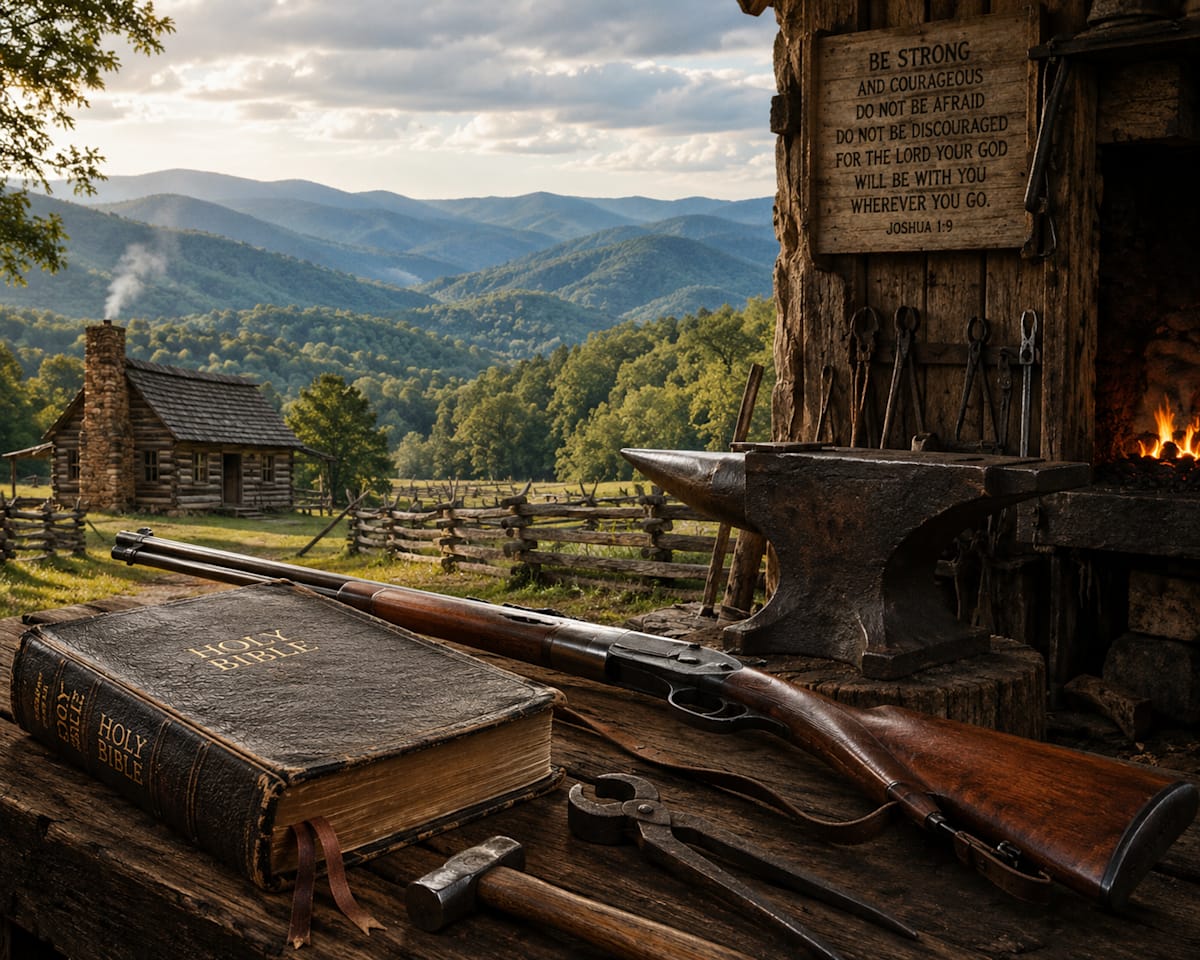
My multiple times great uncle, Isaiah “Zade” Wilcox, was born in 1796, and his own great uncle was the renowned frontiersman, Daniel Boone. Uncle Zade grew up as a farm boy in Wilkes County, North Carolina. Described as a natural genius, he learned to make wagons and to manipulate iron and steel, which enabled him to become a good blacksmith and gunsmith.
As an adult, Uncle Zade stood around 5’10” and weighed about 165 pounds. He was a good-looking man with a fair complexion, blue eyes, and straight black hair, but his shoulders were a little stooped and became more so as he aged. He possessed a quick temper and could become enraged, his agitation manifesting in his words and movements, but he could just as quickly control himself and return to a state of peace, pleasantry, and quietude. As a young man, he was occasionally challenged by his peers, who, via insults and blows, tested his manhood, and while he “did not seek pugilistic engagements, [he] accommodated those making a trespass on his good nature.” Politically, Uncle Zade was a “deep and dyed in the wool” Republican, who “believed in one government, one flag, one Constitution, and a government for all.”
Uncle Zade loved hunting and spent much of his time doing so. On one such excursion, he became acquainted with the family of William Greer and reportedly “became all broken up” over William’s daughter, Fannie, a tall, admirable young woman with a good head on her shoulders. After some courting and wooing, he married her, and, along the New River in Ashe County, North Carolina, they started a home and a family, which would eventually include a dozen children. Around 1820, on horseback and pack mules, the William Greer family (including Uncle Zade and Aunt Fannie) migrated to the Three Forks of the Kentucky River in what is now Owsley County, Kentucky. Within a couple of years, though, feeling homesick and fearing Indians, they returned to North Carolina.
Uncle Zade never had an opportunity for a formal education, but he managed along the way to learn how to read and cipher. He possessed few books, but one of them was the Bible, and when he began to immerse himself in it, he came to realize his fallen state. He “implored God’s mercy, received pardon, and was called to preach the Gospel that he had been reading.” At first, he had fought the call, but his mind was restless, and his soul felt no peace. Finally, he told God he would try, and in that moment of obedient surrender, the Holy Spirit enabled him.
Uncle Zade subsequently preached to many crowds and became well-known within the Baptist church. His heartfelt sermons and prayers for “those lost by Adam’s transgressions” were “made by groanings and utterings of the Spirit” and were “destined to reached the Courts of Heaven [and] pierce the ears of a kind Savior, Jesus Christ.” But Uncle Zade occasionally wrestled with his own sin nature, and there came a time that he forgot his Maker and exchanged his dependence on God for self-reliance. As he would state about himself, “Sometimes Old Zade gets into very deep water and 'tis with much difficulty he wades out!” Although he attempted to continue preaching, he had lost his strength in the Lord. “The enlightening Spirit had taken its flight.”
Feeling weak and wretched, Uncle Zade deserted his family and sojourned for a time – first, back to Kentucky, and then in the rough country surrounding the Elk River in what eventually became West Virginia. There, he hunted, trapped, made guns, and lived in dissatisfaction and relative isolation. Around 1847, his father found him and persuaded him to return to North Carolina, but Uncle Zade only made a brief reappearance there before returning to Kentucky and eventually going to Pound River, Virginia.
It was there, around 1850, that Uncle Zade met and took a second wife despite the fact that Aunt Fannie was alive and well in North Carolina and seemingly without a bill of divorcement. Wife number two, Sallie Mullins, was a tall, black-haired woman with dark eyes and a dark complexion. The couple had an agreeable marriage, and Aunt Sallie was very kind and devoted to Uncle Zade. Their eight children who lived to adulthood, as well as one or two sets of twins who died in infancy, brought Uncle Zade’s total offspring to more than twenty.
For a while, Uncle Zade and Aunt Sallie lived at Pound Gap, five miles below the top of the Cumberland Mountains. Uncle Zade worked as a blacksmith there until around 1854, when he and Aunt Sallie moved to Kentucky, where they settled on Shelby Creek in Pike County for nearly a decade. It was there, about 1856, that Uncle Zade returned to the Lord and resumed preaching the Gospel. In 1863, he and Aunt Sallie again relocated, this time settling on the Little Sandy River in Carter County, Kentucky.
Uncle Zade died in 1879. He had preached on a Sunday morning, subsequently contracted pneumonia, and died peacefully the following Wednesday. Dressed in his suit, he was buried on Thursday on a hillside along Little Sinking Creek, but in 1893, with the consent of his family, he was exhumed and taken to a family cemetery on Deer Creek, where he was reinterred beside one of his sons.
So, here's to the memory of Uncle Zade, pioneer smithy, hunter, and preacher, who was imperfectly human and full of wanderlust, but hopefully and ultimately found his eternal rest and satisfaction in Jesus.
[Reference: The journal of Uncle Zade’s grandson, Francis Marion Wilcox.]