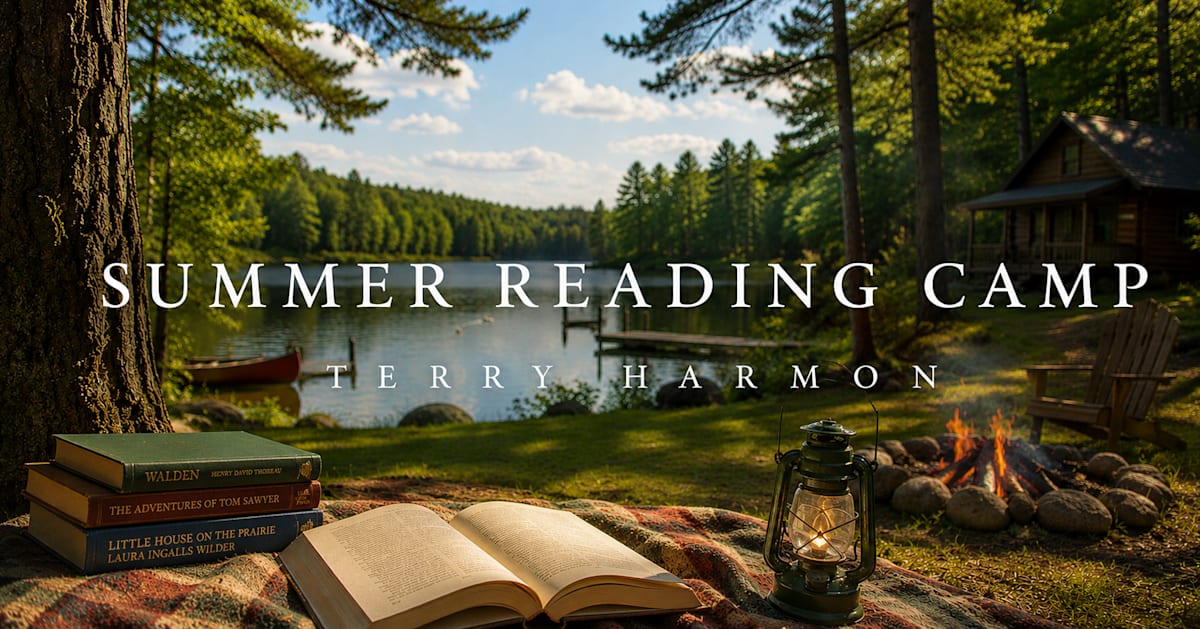
This morning, I spoke to around a dozen kids at a summer reading camp. Although once upon a time, as a student teacher, I taught middle schoolers, kids are not my typical audience, particularly over the course of the past few years of being invited to speak about a true crime book I wrote. Still, I accepted the invitation with equal measures of curiosity and slight trepidation. Kids can be a tough audience in that they are super discerning and can see straight through you if you’re not on top of your game.
At their reading camp, these kids had been studying about fairy tales, fables, and tall tales, and I was asked to briefly share about the Jack Tales. Although I have long been familiar with the Jack Tales, my admission to the inviting teacher that I had never told a Jack Tale did not dissuade her. The invitation stood and I was committed to appear.
My local readers are also likely acquainted with the Jack Tales, but for those who are not, these are southern Appalachian folk tales believed to have originated in England and brought to the colonies by early settlers who, by way of oral tradition, passed them down to subsequent generations.
The Jack Tales follow the adventures of a clever, albeit sometimes lazy, young boy named Jack, who often finds himself in precarious situations, but in the end, he typically uses his wits to outsmart giants, kings, witches, and magical creatures. Think “Jack and the Beanstalk” a la Tom Sawyer's savvy and Jethro Bodine's backwoods naivete.
Upon entering the classroom, I found the kids sitting around a long table, and they turned their heads to give their visiting stranger a once over. I waited as they completed their current exercise – a version of Wheel of Fortune in which they took turns suggesting letters to fill in the blanks. Ultimately, sans Vanna White, “THE LAST DAY OF READING CAMP” was revealed on the whiteboard. Not only was I appearing to them on the last day of camp, but now I had the added pressure of being a parting impression.
When my turn came, I began by introducing myself, and a cherub-like blonde-headed girl asked the first question. “Do you know Daniel Boone?” I told her I never knew him personally, but I did know of him - he who was the namesake of our town, and she proceeded to tell me how many greats of an uncle he was to her. I was impressed that one so young had such an understanding of her family tree – a genealogical kindred soul. I told her that Daniel was my uncle as well, so she and I must be cousins. That seemed to please her, and she smiled sweetly in response.
I told my young audience I was a native of Boone, and, sensing a hesitancy of understanding of the word “native,” I explained that that meant I was born in Boone. This immediately led to the next question. “How old are you?” I challenged them to guess, which resulted in answers ranging from 57 to 82.
When I asked what holiday was approaching, they answered “July the Fourth.” One boy knew we would be celebrating our country’s 250th birthday this year. Most understood it to be an acknowledgement of our independence, but there was some haziness as to which country we had gained that independence from. One girl offered China, which, in retrospect, may have revealed a deeper wisdom than was evident on the surface. In fact, she may not be far off the mark in terms of a futuristic independence to be won. I can envision it now…disgruntled consumers throwing imported Chinese goods – smart phones, laptops, gaming consoles, fireworks, and artificial Christmas trees – into Boston Harbor. A Boston Temu Party, if you will.
I told the kids how immigrants to our country brought their ways of life with them to America – their ways of speaking, their clothing and food, customs and traditions, their music and even the stories they told, one example being the Jack Tales. I shared with them how, in North Carolina, the Jack Tales were told in the 1800s by my great, great, great-granduncle, Council Harmon, to his children and grandchildren.
After this brief introduction, I “commenced to tellin’” the two Jack Tales I had selected – one being a variation of “Jack and the King’s Daughter” and the other being “Jack and the Robbers.” The kids were quietly attentive and seemed to thoughtfully process the tales. One boy astutely concluded that Jack could not be faulted for some of his missteps because the instructions his mother had given him were not particularly clear. This solidarity among youngsters – between this boy and Jack – reminded me of Opie on an episode of The Andy Griffith Show:
Opie: "Is Arnold going to get spanked, Pa?"
Andy: "Don't you think he deserves it?"
Opie: "I don't want to say. After all, he is one of my own kind."

I admire these kids, who could have been doing any number of other activities on this beautiful summer day, yet chose to attend reading camp. When I was a kid, I enjoyed perusing the dictionary, learning the pronunciations and meanings of words, and I liked reading encyclopedias. I also enjoyed buying books at my school’s periodic book fairs and borrowing books from the Bookmobile that made summer rounds in my neighborhood – the closest thing I had to a summer reading camp - but I was never a voracious reader.
During my high school years, I often wrote papers based on books that had been made into movies I had seen or on dust jacket book summaries, and I was a huge fan and consumer of Cliff’s Notes. All these years later, and especially in light of my writing aspirations and the fact that it’s said the best writers are readers, I recognize how I shortchanged myself.
So, kudos to these kids who love to read. One girl said in parting, “I don’t like that this is the last day of reading camp.” But I have no doubt that these kids’ love of books will continue throughout the summer and beyond, and it gives me hope.