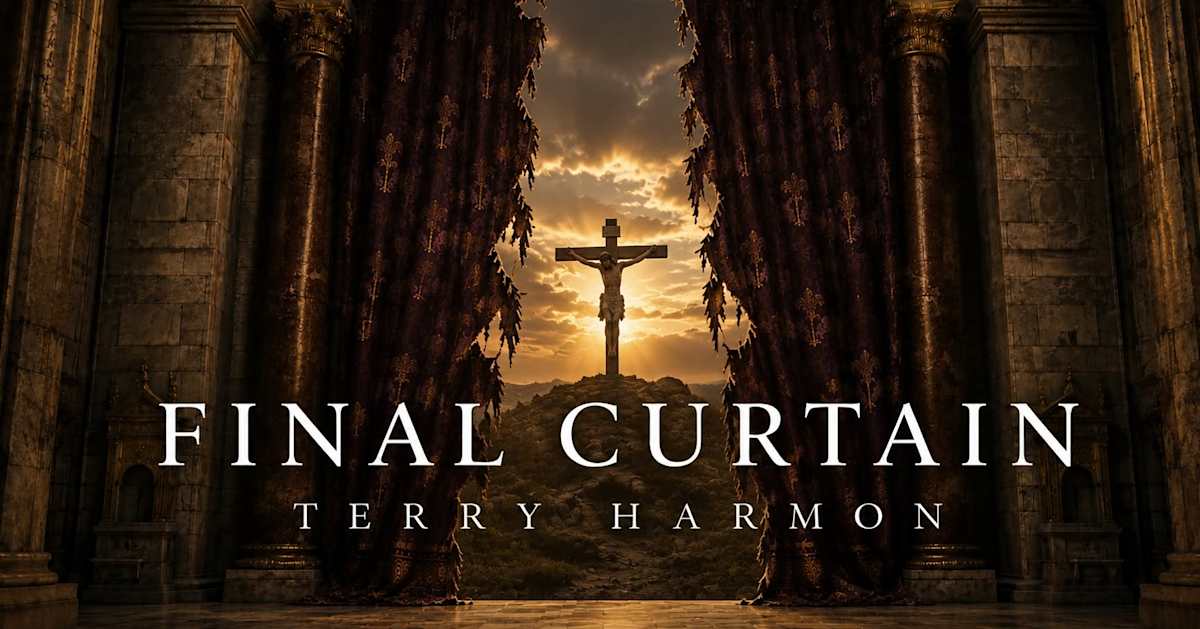
Three of the four gospels – Matthew, Mark, and Luke – speak of the curtain of the temple in Jerusalem being torn in two at the same moment Jesus died on the cross.
This was the curtain that separated the larger portion of the temple from the chamber known as “the Holy of Holies,” which contained the Ark of the Covenant and was considered to be the earthly dwelling place of God’s presence. In this sense, the curtain symbolized a barrier of separation between a holy God and sinful humanity.
The covenant that God established with the children of Israel entailed that they obey His laws, including specific instructions for offering sacrifices. The Holy of Holies could only be entered once a year by a priest on the Day of Atonement, when the priest would offer an animal (blood) sacrifice for the sins of the people.
The need for a blood sacrifice is mentioned several times throughout the Old Testament, and as early as the Garden of Eden. When Adam and Eve sinfully disobeyed God’s instruction, they lost their innocence, and in their guilt and shame, they attempted to hide from God. They also tried to cover their nakedness with figs leaves, but God replaced the leaves with animal skins. These actions spoke to the greater truth that human effort to cover sin is futile; only a blood sacrifice could atone for wrongdoing.
Later on, when God tested Abraham’s faithfulness by asking him to sacrifice his only son, Isaac, it was God who ultimately provided a substitutionary blood sacrifice (a ram) instead.
When God intended to deliver the children of Israel from the bondage of Egypt, one of the ways He brought Pharoah to a place of compliance was the tenth and final plague, in which the firstborn of every creature was struck dead. To spare the Israelites from this plague, God instructed them to sacrifice lambs and place the blood on their doorposts. He promised them, “When I see the blood, I will pass over you.”
The book of Leviticus gives us God’s foundational principal of atonement: “For the life of the flesh is in the blood, and I have given it to you upon the altar to make atonement for your souls; for it is the blood that makes atonement for the soul.”
Fast forwarding hundreds of years, when God sent His Son Jesus, the need for a blood sacrifice to atone for sin remained. Prophets of the Old Testament foretold of Jesus, including Isaiah, who said the coming Savior would be oppressed and afflicted and led like a lamb to the slaughter.
The New Testament’s four gospels give full accounts of the crucifixion and death of Jesus, and later books inform us of the fuller impact of His sacrifice. 2 Corinthians tells us that, for our sake, God made Jesus (who was without sin) to be sin, so that in Him, we might become the righteousness of God. Ephesians tells us that Jesus loved us and gave Himself up for us as a fragrant offering and sacrifice to God. 1 Peter tells us that we were ransomed with the precious blood of Christ, like that of a lamb without blemish or spot. And then Hebrews sums it up so well, telling us that a single offering – the body of Jesus Christ – has sanctified us once for all and no longer requires daily sacrifices by priests.
Returning to the temple curtain, Matthew and Mark provide us with the added detail that it was torn from top to bottom. Keep in mind this was no ordinary curtain. It is believed that it measured roughly 60 feet high (the equivalent height of a 4- to 6-story building) and 30 feet wide, and that it was about as thick as the width of a man’s hand (roughly 4 inches).
In other words, the curtain could not be easily torn, and the fact that it was torn from top to bottom was indicative of a divine act of God rather than human effort. It symbolized that, by virtue of the blood sacrifice of His Son on the cross, God was removing the barrier between Himself and mankind.
This ended the old sacrificial and priestly system and established a new covenant, whereby Jesus Christ, the ultimate and final sacrifice, became our Great High Priest, serving as the mediator between God and man.
I don’t need an earthly priest to access God once a year on my behalf. Because Jesus’ sacrificed Himself for my sins, and because I have accepted Him as my Savior, I can go to God any time, any place, and anywhere. And that’s a beautiful and blessed thing.
I’m thankful that a great big curtain was torn in two by my great big God!