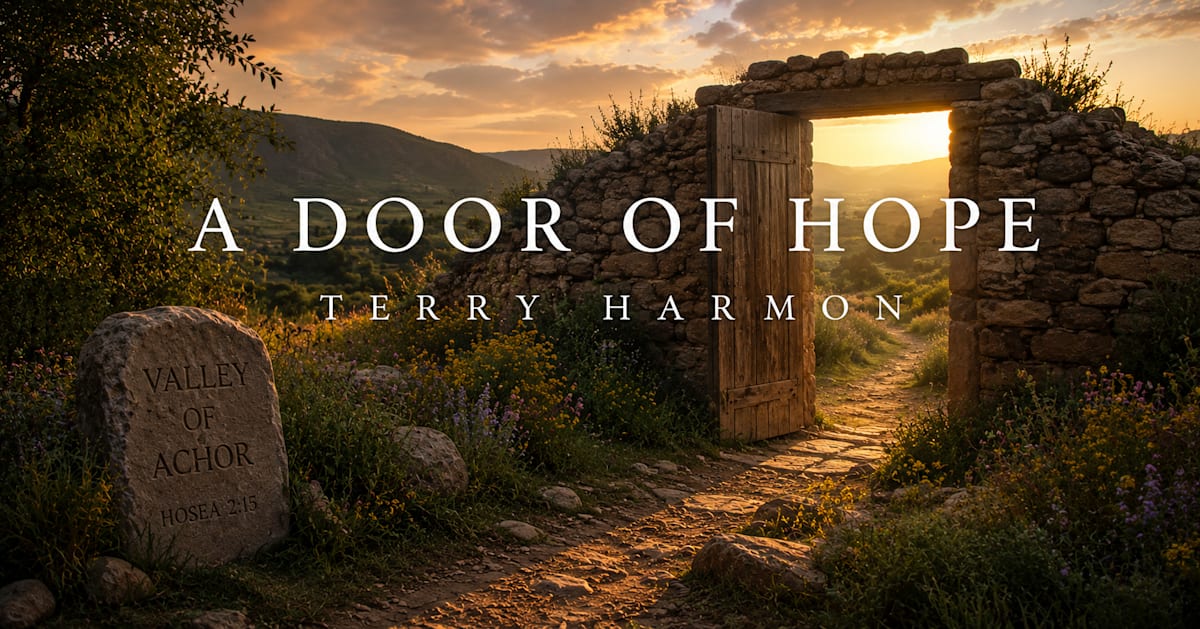
As I was reading in the book of Hosea today, a short but beautiful phrase caught my attention:
“A DOOR OF HOPE”
In the preceding verses, God had portrayed the idolatrous Kingdom of Israel as an unfaithful wife and the Valley of Achor as a place for her judgement. To symbolize the strained relationship between God and Israel, God instructed the prophet Hosea to marry an adulterous woman, and among their children were Lo-ruhamah and Lo-ammi. “Lo” being the Hebrew word for “no” or “not,” the translations of these children’s names are “no mercy” and “not mine,” which reflected God’s judgement upon and disassociation with Israel.
But then the story takes a turn. Suddenly, Lo-ammi becomes Ammi (“mine”), and Lo-ruhamah becomes Ruhamah (“mercy’), and we see the judgement of God give way to His loving character and redemptive purpose. And in the midst of the Valley of Achor (recognizing that valleys signify low points), He offers a door of hope.
But hope for what?
Although this passage is specifically painting a picture of hope for a restored relationship between Israel and God, we are afforded one of those tremendous moments when scripture can be applied to any number of situations in our own lives.
What low point are you presently needing a door of hope for?
Hope in light of the bad medical news you recently received?
Hope for that job you desperately need?
Hope for deliverance from something that has a chokehold on your life and steals your joy?
Hope for better relationships with your family?
Hope for brighter days ahead?
Hope for something to fill that gnawing emptiness in your soul?
I’m thankful that God is rich in love and mercy and graciously provides us with a door of hope in response to our needs. In fact, the Bible tells us that door is not just some inanimate thing; it is a Person. Jesus says, “I am the door: by me if any man enter in, he shall be saved….” It is in Jesus that our ultimate door of hope for any circumstance of life is found.
But a paraphrased reminder from pastor and author Paul Tripp regarding our hopeful expectations:
The Word of God promises us that, when we hope in the Lord, we will not be disappointed. That does not mean God will submit to our timelines or always deliver what we hope for in the way we expect, but He will always care for those who trust in Him. He will give us everything He has promised us, and He will generously provide what is best for us. Many of us may struggle with questions about God’s goodness, faithfulness, and love, not because He has failed to keep His promises, but because we have different agendas than He does. We may have an idea or expectation that a good God should give us a life that is comfortable and pleasurable and absent of suffering, but God is not working to deliver our personal definition of happiness. If that is what we are hoping for, we will be disappointed with God, and we are going to wonder if He loves us. But the difficulties we face are not signs that God has turned His back on us. God is after something better: our holiness — that is, the final completion of His redemptive work in us, which includes deep and abiding happiness in Him despite our circumstances.
The English minister Edward Mote beautifully expressed biblical hope in these verses of a very familiar hymn:
“My hope is built on nothing less
than Jesus' blood and righteousness;
I dare not trust the sweetest frame,
but wholly lean on Jesus' name.
“His oath, his covenant, his blood,
support me in the whelming flood;
when all around my soul gives way,
He then is all my hope and stay.”
Whatever you may be facing, remember that God loves you and has provided a door of hope. Look for it, for it most certainly may be found. And when you have found it, enter into its promises.